← All recordings & courses
ADHD & Sleep: 6 Week Course
On-demand video course · 6 sessions

ADHD & Sleep: 6 Week Course

with Heather Darwall-Smith

£60

  • ▶ 6 sessions
  • Over 10 hours of video
  • Instant access
  • Yours until Sep 2027
  • Full refund guarantee

About this course

Uncover the connection between ADHD and sleep, and find a better way to sleep and rest. Up to two-thirds of people with ADHD face unique challenges with sleep, from difficulty falling and staying asleep to feeling out of sync with their natural body clocks — yet sleep problems are one of the most overlooked aspects of ADHD. In this six-session course, sleep specialist and psychotherapist Heather Darwall-Smith brings science and psychotherapy together to explain why ADHD brains find rest so elusive and what can actually help — from calming racing thoughts and working with your body clock to navigating hormones, emotions and executive function. This is the complete recording of the live course, including the audience Q&A from every session.

Everything you get

  • All 6 sessions with sleep specialist Heather Darwall-Smith — over 10 hours of teaching, including the live audience Q&A
  • A full transcript of every session to read alongside — handy for revisiting a strategy or catching up at your own pace
  • ADHD-friendly strategies you can start using straight away, from calming racing thoughts to working with your body clock
  • Your own private course hub — every session in one place, on any device
  • Instant access by email after checkout — watch and rewatch until September 2027
  • Full refund if it’s not for you — just ask

The course, session by session

Heather Darwall-Smith — Wide Awake: Understanding the ADHD-sleep connection
Session 1

Wide Awake: Understanding the ADHD-sleep connection

with Heather Darwall-Smith

Heather opens the course with the big picture: a dysregulated nervous system makes for unstable sleep, and somewhere between half and four in five adults with ADHD live with chronic sleep problems. She unpacks the three drivers — dopamine, a body clock that runs late, and hyperarousal, pictured as a shaken-up fizzy drink bottle — then turns to time blindness, sleep inertia, the evening “second wind”, and why the shame so many people carry about sleep is misplaced.

  • Why so many adults with ADHD have chronic sleep problems
  • How dopamine, a late body clock and hyperarousal keep you wired
  • Why ADHD mornings can feel like pushing mud uphill
  • Why standard “just go to bed earlier” advice so often fails
Heather Darwall-Smith — Wired but Tired: The science of ADHD and sleep
Session 2

Wired but Tired: The science of ADHD and sleep

with Heather Darwall-Smith

Heather digs into the science of feeling wired but tired, reframing ADHD as a condition of arousal regulation, not just attention. She explains delayed clock genes and the cortisol–melatonin “seesaw”, the brain’s search for dopamine late at night, hyperfocus, time blindness and the faint internal signals that should tell you you’re sleepy — then shares gentle strategies that work with an ADHD brain: soft stops instead of hard deadlines, automated cues, a simple sleep diary and the power of self-compassion.

  • Why ADHD is a condition of arousal regulation, not just attention
  • How the cortisol–melatonin “seesaw” shapes your night
  • Why missing your sleep window isn’t game over
  • Soft stops and automated cues that support working memory
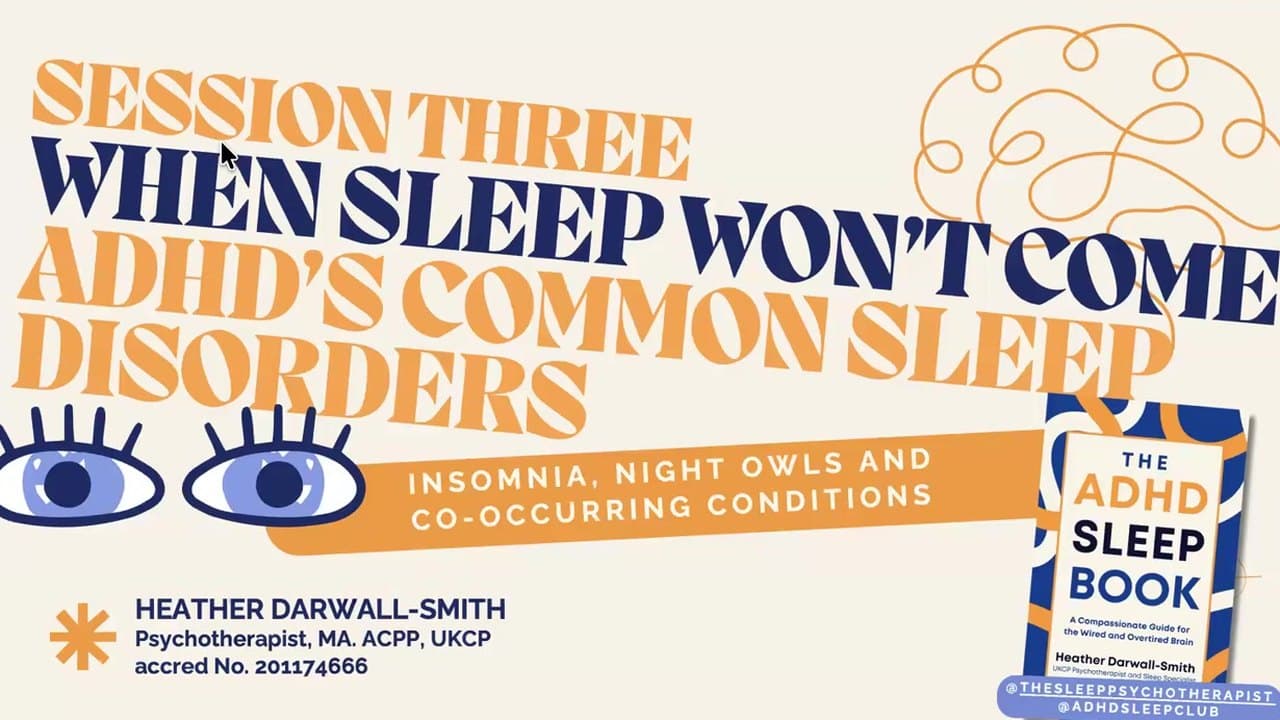
Heather Darwall-Smith — When Sleep Won’t Come: ADHD’s common sleep disorders
Session 3

When Sleep Won’t Come: ADHD’s common sleep disorders

with Heather Darwall-Smith

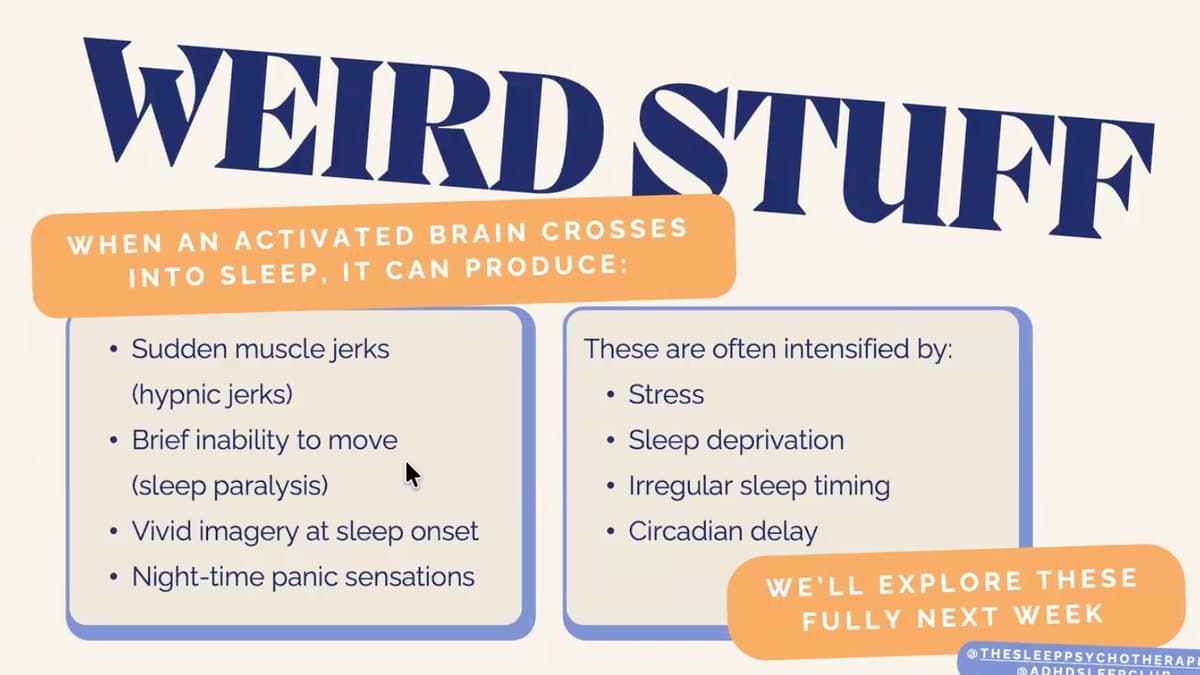
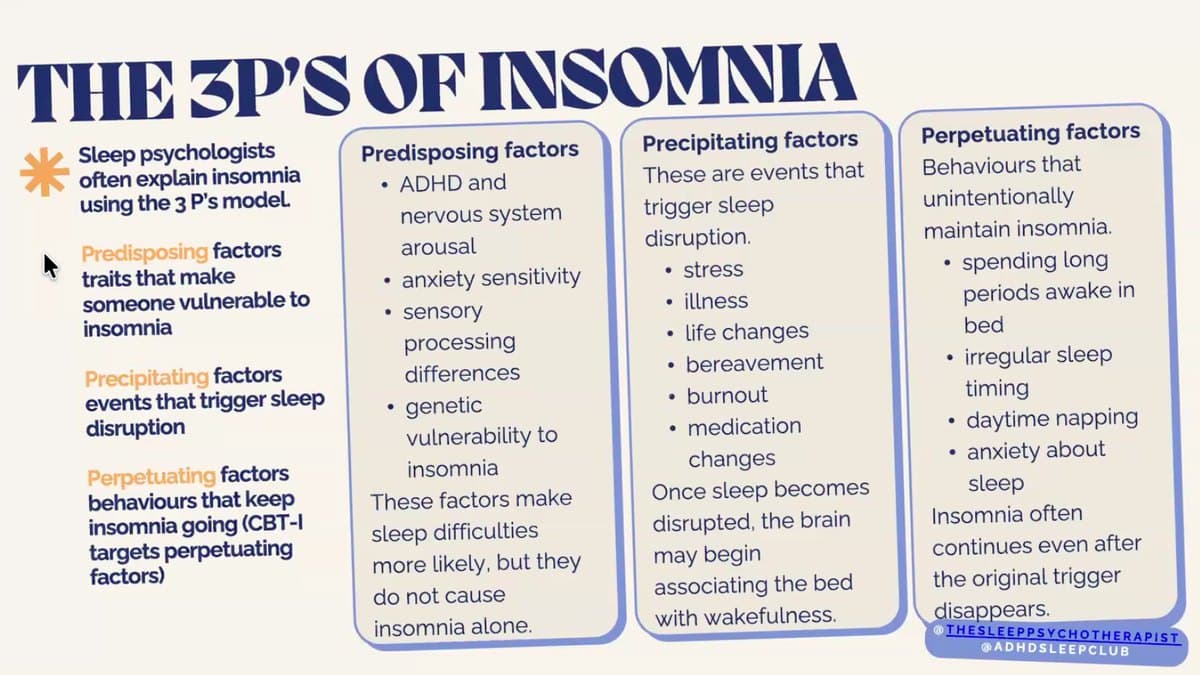
Heather moves from disrupted sleep to the diagnosable sleep disorders that are far more common with ADHD. She explains insomnia through the “three Ps” model, delayed sleep–wake phase disorder, restless legs and periodic limb movements, sleep apnoea and the risks of drowsy driving, and parasomnias from hypnic jerks to nightmares — along with sleep compression, a dream-completion technique for nightmares, and the three questions to answer before you see your GP.

  • How insomnia starts and persists: the “three Ps” model
  • Telling ADHD restlessness apart from restless legs syndrome
  • The warning signs of sleep apnoea, and why diagnosis matters
  • What to prepare before you talk to your GP
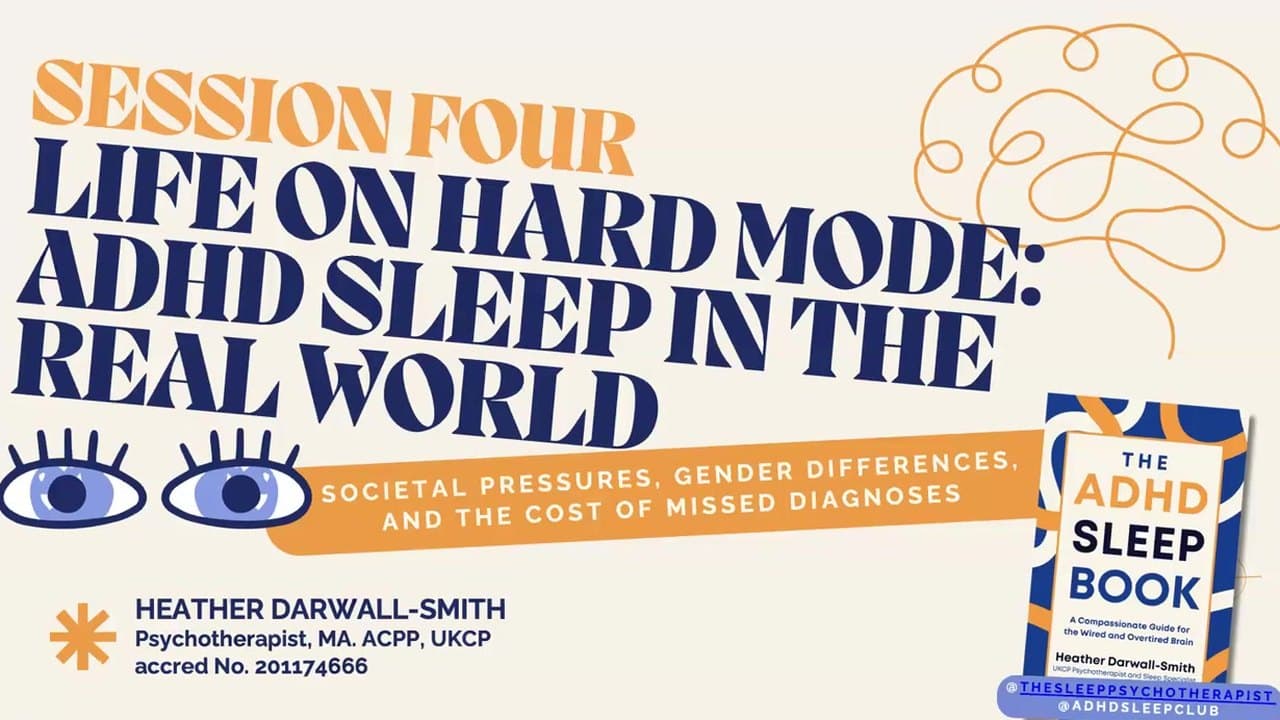
Heather Darwall-Smith — Life on Hard Mode: ADHD-sleep in the real world
Session 4

Life on Hard Mode: ADHD-sleep in the real world

with Heather Darwall-Smith

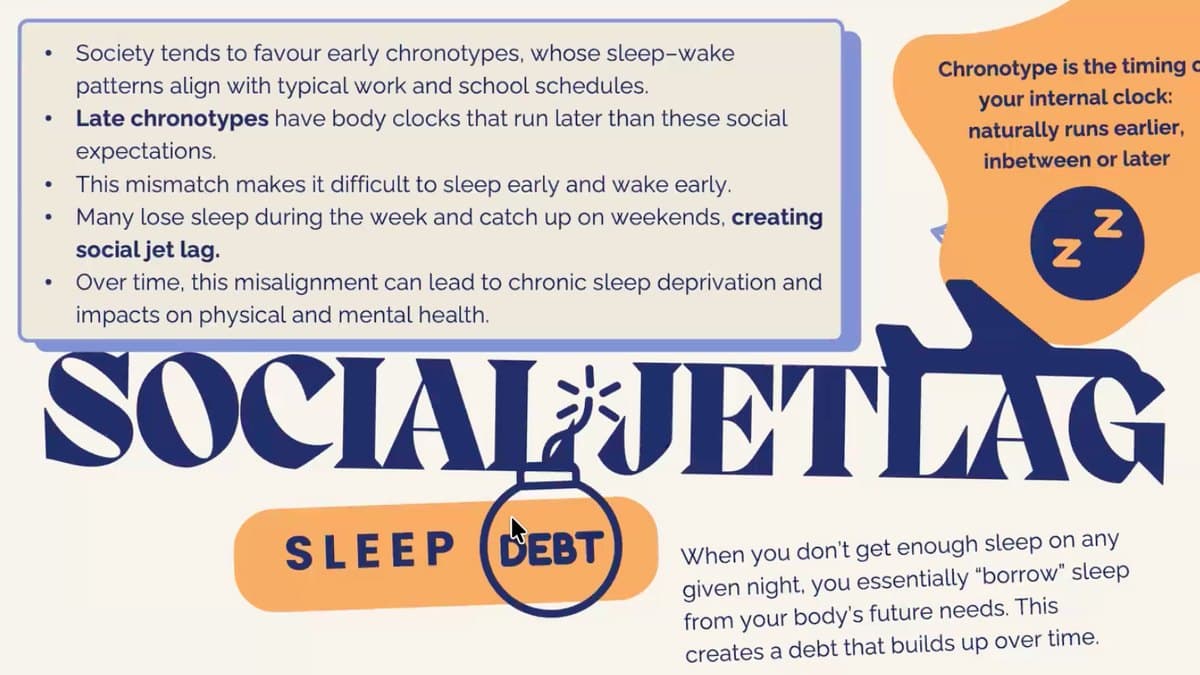
Why does a nine-to-five world feel so hard with an ADHD body clock? Heather explains how early starts cut into REM sleep and create constant social jet lag, and explores chronodiversity, night and shift work, and “anchor sleep” for irregular schedules. She looks at alcohol as an off-switch, rejection sensitivity at night, and the gender bias that leaves so many women diagnosed late — before closing with practical ways to ask for what you need at work, at school and from your GP.

  • Why early starts cut REM sleep and cause social jet lag
  • How anchor sleep can steady shift workers’ sleep
  • Why alcohol disrupts REM sleep, and what to try instead
  • How to ask for adjustments at work, school and the GP
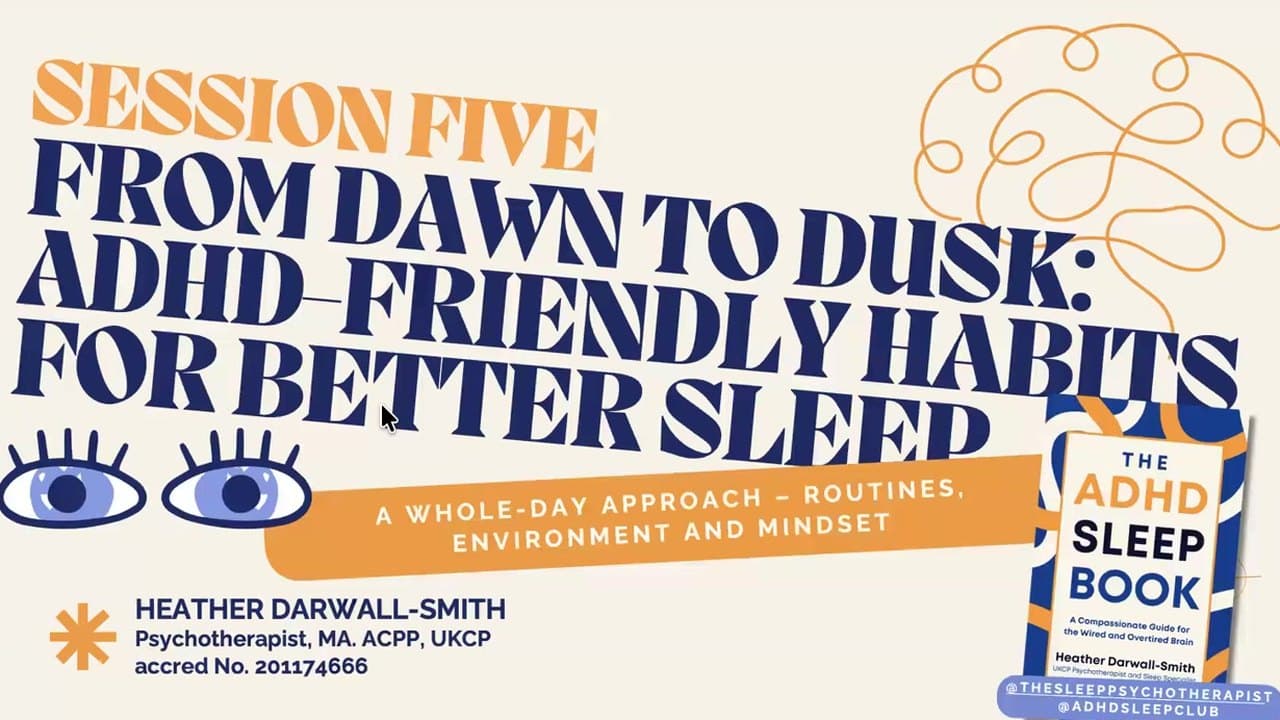
Heather Darwall-Smith — From Dawn to Dusk: ADHD-friendly habits for better sleep
Session 5

From Dawn to Dusk: ADHD-friendly habits for better sleep

with Heather Darwall-Smith

The course’s toolbox session: Heather walks through an ADHD-friendly day from waking to lights-out. She makes the case for a consistent wake time as your biggest lever, then covers morning light, sunrise and vibrating alarms, caffeine timing, movement, the evening second wind and revenge bedtime procrastination, and building a gentle wind-down together. Along the way she teaches three breathing techniques, talks about sleep with teenagers, and explains when tools like sleep restriction are used.

  • Why a consistent wake time is the biggest lever you have
  • How to time caffeine so it helps rather than hurts
  • Three breathing exercises for winding down and night waking
  • How to handle second winds and revenge bedtime procrastination
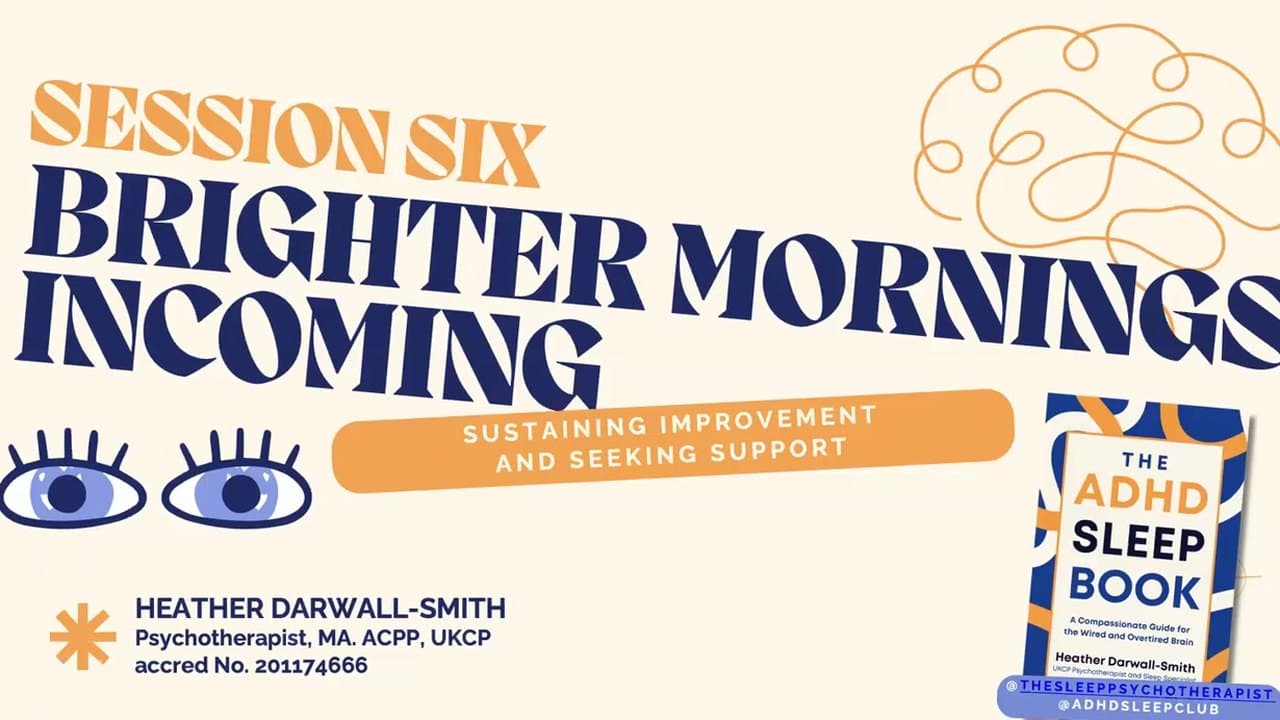
Heather Darwall-Smith — Brighter Mornings Ahead: Sustaining improvement and seeking support
Session 6

Brighter Mornings Ahead: Sustaining improvement and seeking support

with Heather Darwall-Smith

In the final session Heather pulls the course together into a plan you can sustain. She explains why 3–4am waking is normal, how to handle setbacks without all-or-nothing thinking, and how to build your own coping plan for bad nights. Then she answers the topics attendees asked for — how menopause can unmask ADHD and disrupt sleep, why ADHD brings more vivid dreams and nightmares, and what melatonin really does — and closes with when and how to seek professional help.

  • How to build a coping plan and bounce back after bad nights
  • Why menopause can unmask ADHD and disrupt sleep
  • What melatonin really does — a time cue, not a sleeping pill
  • When to seek help: GP visits, sleep studies and CBT-I

A peek inside

ADHD & Sleep: 6 Week Course — preview 1
ADHD & Sleep: 6 Week Course — preview 2
ADHD & Sleep: 6 Week Course — preview 3
ADHD & Sleep: 6 Week Course — preview 4

Your speakers

Heather Darwall-Smith

Heather Darwall-Smith

UKCP-accredited psychotherapist and sleep specialist

Heather Darwall-Smith is a UKCP-accredited integrative psychotherapist and the author of How to Be Awake (So You Can Sleep Through the Night) and The Science of Sleep. Living with ADHD, dyslexia and hypermobile Ehlers-Danlos syndrome, she brings both personal insight and professional expertise to her work. Before training as a psychotherapist, Heather spent two decades in the creative industry, where her fascination with the mind–body connection led her to study bodywork and design a corporate stress awareness programme. She went on to earn an MA in Core Process Psychotherapy, followed by specialist training in sleep medicine and cognitive behavioural therapy for insomnia at the University of Oxford. Today, Heather runs a private practice where she specialises in sleep, ADHD and overall well-being, helping people better understand the links between mind, body and rest.

Common questions

How do I watch the course?

As soon as your payment goes through, we email you a personal link to your private course hub — all six sessions and their transcripts in one place. It works on any device with a browser, and there’s no account or password to set up.

How long do I have access?

You can watch and rewatch as much as you like until September 2027 — plenty of time to take the course at your own pace, whether you watch it all in a weekend or take one session a week, like the live cohort did.

Is this live? Do I need to show up at set times?

No — these are the full recordings of the complete six-session course Heather Darwall-Smith ran live in spring 2026, including the audience Q&A from every session. Watch whenever suits you.

Do I get slides or handouts?

Heather presents her slides on screen throughout every session, so you won’t miss a thing — but they aren’t available to download separately, as they draw on her new book. Pause and screenshot anything you’d like to keep. Every session also comes with a full, tidied transcript on your course hub, so you can read back over anything at your own pace.

Is this medical advice?

No — the course is educational. Heather explains what the research says and shares strategies that help many people with ADHD, and she’s clear about when to talk to your GP or a sleep clinic. It isn’t a substitute for personal medical advice or diagnosis.

What if it’s not for me?

We offer a full, no-quibble refund — just ask. If the course isn’t what you hoped for, reply to your receipt and we’ll sort it, no questions asked.

Who is this course for?

Anyone with ADHD (diagnosed or suspected) who struggles to fall asleep, stay asleep or get up in the morning — and partners, parents and professionals who want to understand why. No prior knowledge is needed.

Ready to start? All 6 sessions, instantly — £60.